Editorial: Issue 23/ September 2026
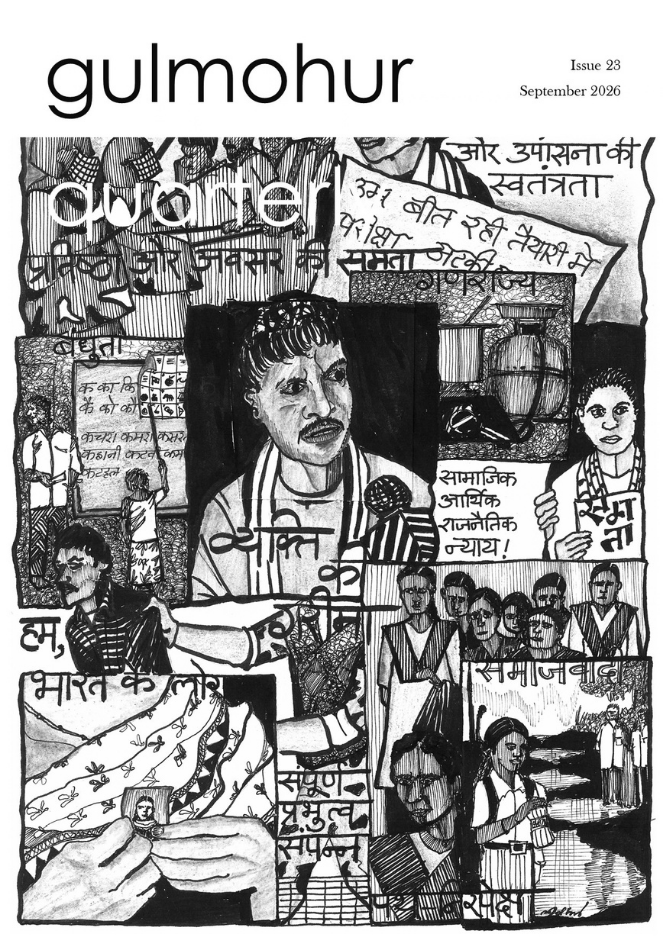
This issue opens with a bold black-and-white ink-sketch of resistance and democratic assertion. Many thanks to the teacher and artist Nidhin Donald for illustrating this for us! On the darkest nights, we seek camaraderie and community, in search of light, perhaps, on the way of making light. The solidarities forged during times of struggle, the coming-together of students and youth across campuses, of citizens against the many injustices, we hope, flourish into structures of support and fellowship during better times.
The short fiction in this issue deals with the themes of the historical, the political, and the everyday. A story recounts a child’s idea of home and her imaginative-speculative response to normalized bitterness and cruelty from a parent. A translated narrative from Malayalam tells us of a lawyer who is working on cases related to the SC/ST act, or the “atrocities” act and her navigation through everyday encounters of casteism. At a lunch gathering with her colleagues she wonders: “do these dishes also carry the caste of their cooks?” It is pertinent for readers who first invisibilize caste and then feign ignorance and shirk responsibility in the event of an atrocity against the oppressed castes. Another conversational story brings us a few chuckles as it manifests the figure of a father and the corresponding familiarity of such relationships. A historical fiction takes us on a poetic journey of loss and grief through the thoughts and throbs of the last Mughal emperor, Zafar. As he poignantly reflects in his poetry: “I am not at home/ In this ruined landscape.” Another story takes us through the tense and simultaneously tender situation of two working women, co-wives of a man co-existing, and their journey from hellish discord to grateful grace.
The poets here are thinking about the ecological, the mystical, and the absurd, amidst a lot else. A poem paints the forming of the fig in close proximity to flesh: “ripe enough for the mouth of the world,/ which can never taste the story whole.” A poet reflects on the crux of faith. A peculiar sadness emerges from the figure of a suffering soul, as the poem begins: “After seven years I forgot/ The birthday of my dead son.” A mythology is invented to echo the threats of curses and forewarnings. A delicate poem brings two leaves in conversation. Another quirky verse speaks of longing for home and comfort from the perspective of journeying. A set of translations from Hindi emphasizes on the routine cruelty of our times, the absurd violence everywhere. A poem from Gujarati speaks of the dichotomy between the “savarna” image of the fair goddess and the “dark, ugly, half-dressed” likeness of the Mahakali to the oppressed people. The same poet dedicates another poem to Father Stan Swamy, and questions the “cowardly, dark British” state. We also have a lyrical translation of highly metaphorical and somewhat mystical poems from Persian/Farsi. Another poet documents the absurdity of high-rises and the un questioned altering of landscapes. A feminist love poem defies the “televised bigoted accusations of ‘savagery’.” A poet also gives a fantastical worldview of a five-year-old and their questions and wonderments, and draws a grandfather child bond into a Sufi-like love.
The essay in this issue analyzes Amitav Ghosh’s Gun Island and thinks of eco logical imbalance and its consequences through the uncanny sense of being utterly fragile in a horribly unpredictable world. “Do we respond to political atrocities that mar the historical narrative of civilisation: chattel slavery, human trafficking, economic and cultural plunder, the carceral regime of borders, xenophobia, and segregation, by appealing to universal laws of amnesty and humanitarian aid, in the language of social justice and political rights, or do we create new gestures and praxes for re-comporting ourselves, our bodily capacities and sensory habits, in order to be affected and transformed by that which lies beyond the pale of the familiar?” The photo story here features an account of mural painting in Peshawar, a free-ing and asserting of self-identity and communal claims, by a person from the Khwaja Sira (transgender) community.
*
gulmohur stands in solidarity with the students and activists across the country; the victims of communal hatred and of state violence; the victims of caste and gender violence; the victims of fundamentalist oppression anywhere in the world; and with all those who dissent in the spirit of democracy to safeguard our ever-diminishing freedoms.
*
We would like to express our profound thankfulness to our readers and well wishers everywhere. We are immensely grateful to all our friends (on and off social media) who have helped us reach out. We also thank our contributors for trusting us with their submissions.
*
We welcome critical feedback from our readers. Happy reading!
Editors
gulmohur
September 2026