Editorial: Issue 22/ June 2026
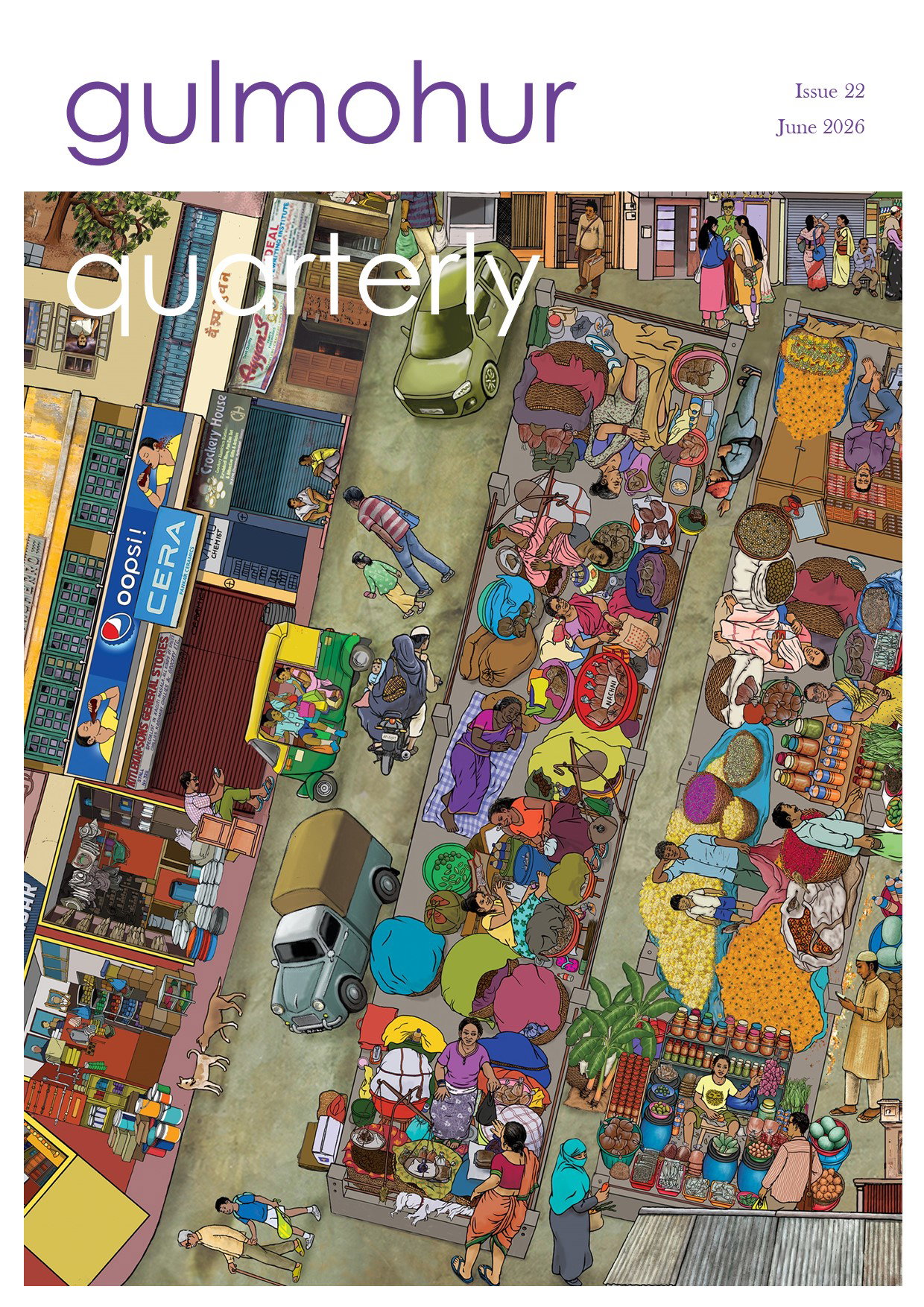
The cover art for this issue has been done, as you’d most likely recognize by the characteristic style of composition and its calm, by the brilliant artist-activist Orijit Sen! A glimpse of the market of Mapusa in Goa, it is a slice of sociality instantly familiar to most of us, by its colours and scents, rhythms and breaks. A creative accompaniment to this artwork features in the form of a poem by the Indo-French poet Ari Gautier: “The street lay tilted like a question / no one had time to read, / and all the answers were selling coriander / by the handful.” With such an engaging mosaic of life on the cover, this quarterly issue is indeed filled with a range of lively concerns.
*
In this issue, love reinforces and war threatens doom. A short story deals with the intensification of love through mundane rituals, while another speculates the movement of desire through domesticity and intellectual companionship. A story in a child’s voice visits a site of death and lets grief wash over different psychological worlds. A dreamy love story framed in Delhi navigates the reality of ‘love-jihad’ while coming to terms with loss and alterity. In a story translated from Urdu, the protagonist finds herself in a distorted, diminishing reality where she forgets faces and recalls ache.
The poetry section brings to us meditations on the political and the personal, setting up the task of making sense of a reordered world. A Hindi-Urdu poet laments the helpless situation of belonging to a religious minority, questioning identity and the appropriation of it. Two simple poems from a Portuguese master reflect on the sensual and its primacy. A poet finds herself enthralled by a sudden compliment in the metro, while another documents a poetic snap of a pilgrim’s journey. Four delicate translations from Marathi put us in the deceptively common yet knotted realm of companionship, longing, and letting go. A poet takes us to the crematorium, while another to the debris of Palestine. A teacher-poet writes down the obvious and glum reality of exhausted students who “pay to commute” and are forced to remain limited by it. A poet contemplates grief subtly: “grief is a discipline / I return to it daily, / kneel, rise, / leave you exactly where you were.” A pigeon-keeper is displaced and destroyed through the law of the bulldozer as a hundred clueless wings ask: where is our home, where do we perch? A set of three poems from Hindi turns around the moral indifference and inaction by narrating from the perspectives of mythological figures who stand apart, stoically, from the ever-warring world. A patient poet advises us on how to read a living page: “If a word loosens, let it fall. / Something beneath it has been waiting longer.” Another poetic questioning takes place in the world of devotion as love, transcending space by becoming a mere dot, transcending time by imagining past lives through pain and compassion. A set of revolutionary poems from Punjabi raises a determined fist against state oppression: “Truth is not All India Radio’s whore / time is no dog.” And in the face of these complex mitigations of the self and the world, there are poems that focus on the finite nature of human life and the underlying tragedy of perpetual unfulfillment. A set of translations from the Bangla reads as post-cards to-and-from Iran, expressing solidarity with the defiance and dignity of its civilization against the capitalist-imperial war.
*
gulmohur stands in solidarity with the activists and intellectuals of the Bhima Koregaon case; the victims of communal hatred and of state violence; the victims of caste and gender violence; the victims of fundamentalist oppression anywhere in the world; and with all those who dissent in the spirit of democracy to safeguard our ever-diminishing freedoms.
*
We would like to express our profound thankfulness to our readers and well-wishers everywhere. We are immensely grateful to all our friends (on and off social media) who have helped us reach out. We also thank our contributors for trusting us with their submissions.
*
We welcome critical feedback from our readers. Happy reading! Happy rains!
Editors
gulmohur
June 2026