Editorial: Issue 21/ March 2026
This issue contains an exciting range of fiction. An Orwellian satire on governmental intrusion shows the protagonist negotiating against the attempts to homogenize and standardize civic life through “structural harmonization” and “aesthetic compliance.” A period-piece translated from Marathi displays the complexity of romance and familial coercion against even the relatively liberated class of women. The story told through a narration of events and confessional dilemmas of diary entries grapples with a woman’s self-understanding through desire and sociality of friendship. Another short story, in a direct descriptive tone, records the afterlife of an underground revolutionary. “Peace, he learned, was not a clean transition. It was paperwork. Interviews. Waiting rooms with peeling posters about development. Promises of rehabilitation that came in instalments too small to feel real.” A translated story from Tamil records the banal evil of caste violence, drawing out the deep resentment of the upper-castes against the minimally upward mobility of the oppressed. Any reader who thinks this to be pure fiction must start reading and engaging critically with anti-caste voices in literature, arts, cinema, journalism, political activism. Another grim story laid out through snippets of dreams and figments of reflection, memory, and fantasy tells us: “Every believable account of a childhood must contain horrors of at least one kind.” In a short story translated from Hindi, we read a solipsist account of love, which many have encountered among their companions and colleagues—love which dwells and dreams inwardly, self-sufficiently, irrespective of the signals received, or not, from its object. Such lovers could be mocked, but in the hands of a sensitive writer, an outline of human psyche is sketched in which delusion and truth collide with tragicomic results. A story takes us to the mining fields of Jharia, where coal dust deposits itself on everything, killing weak children and wrecking helpless workers. The blackness of geography and the bleakness of lives lived in such hells created by corporate-government nexus are fictional only until faced in reality. Another short story shows us the pulls of the heart of a bureaucrat upon a chance encounter with a figure from past and how some phenomena forever remain in the haze eluding full comprehension. The poets in this issue capture the images of the world and isolation, longing and lack; another brings to bloom the light-and-heat-thirsty gulmohar in evocative phrases.
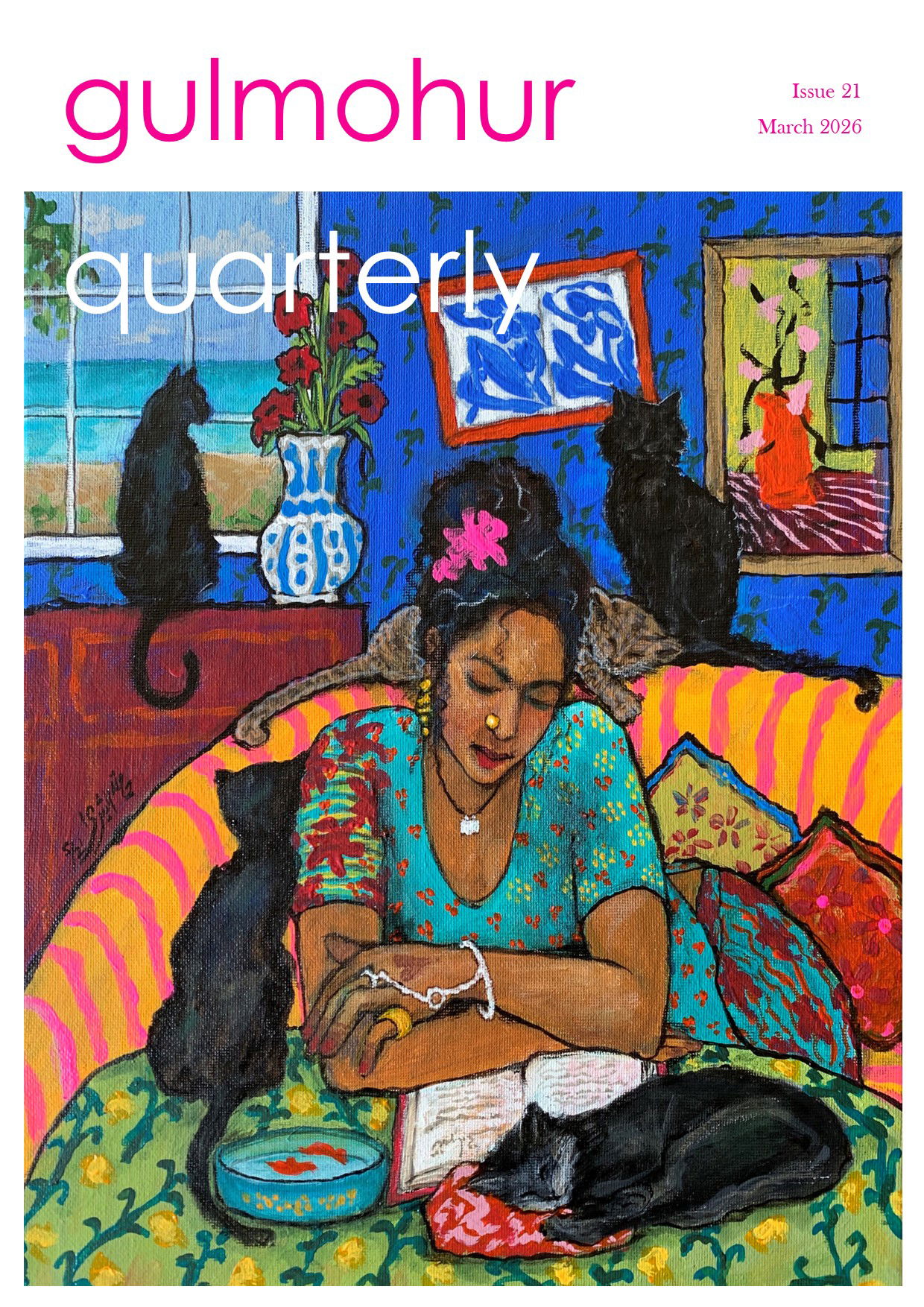
The cover art for this issue is done by the brilliant artist Hamama Tul Bushra, whose vibrancy stands out with assertive confidence and artistic autonomy. Perhaps, the bold colours, for us, are a counter-response to the graying apocalyptic events throughout the world today. It certainly is a powerful and grounded depiction, even reclamation, of womanhood seen through the lens of lived experience.
*
gulmohur stands in solidarity with the activists and intellectuals of the Bhima Koregaon case; the victims of communal hatred and of state violence; the victims of caste and gender violence; the victims of fundamentalist oppression anywhere in the world; and with all those who dissent in the spirit of democracy to safeguard our ever-diminishing freedoms. We register our strong protest against the discriminatory and regressive Transgender Persons Amendment Bill and extend full support to its resistance.
*
We would like to express our profound thankfulness to our readers and well-wishers everywhere. We are immensely grateful to all our friends (on and off social media) who have helped us reach out. We also thank our contributors for trusting us with their submissions.
We feel loved and validated by the financial support we received for our fundraiser in December-January and are glad to have grown into this community of dedicated literature lovers.
*
We welcome critical feedback from our readers. Happy reading! We wish you courage and determination in spirit of the Women’s History Month (March) and the Dalit History Month (April). Jai Bhim!
Editors
gulmohur
March 2026