The Miracle of Intersections: The Cosmopolitan Imaginary of Amitav Ghosh’s Gun Island/ Paromita Patranobish/ Issue 23
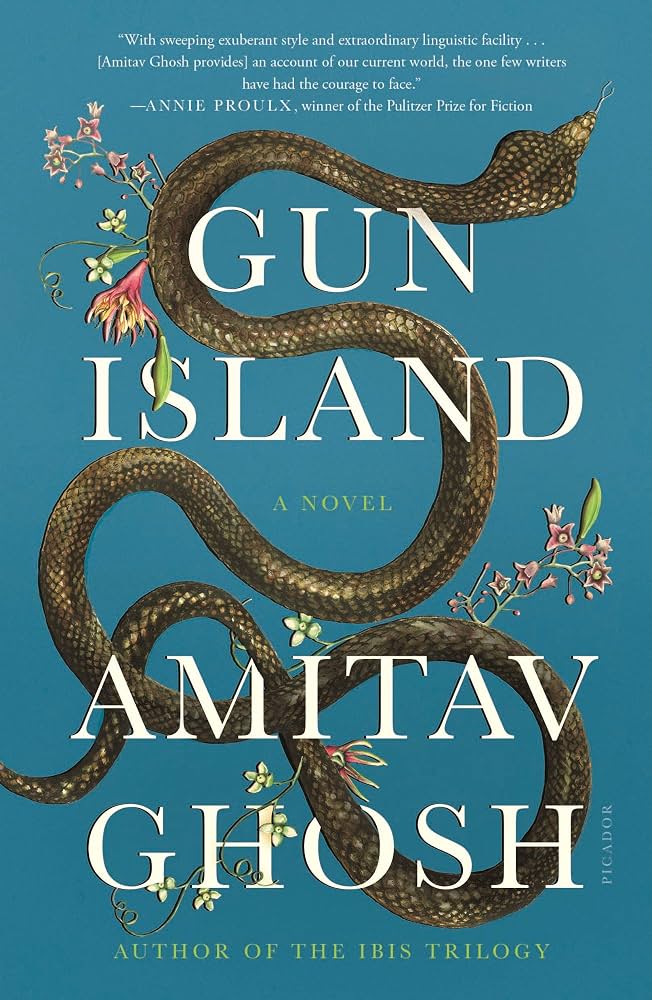
Amitav Ghosh’s Gun Island (2019) is structured around an intriguing idea: the prospect of a single word, in this case, ‘gun’ or bandook, having dynamic histories of travel, mutation, and meaning. One of the several trajectories of the plot of Gun Island involves tracing the etymological vectors of a word, and recording the ways in which its multiple sites of occurrence and contexts of use connect local legend with global histories. This linguistic (and cultural) cosmopolitanism suggested by the structural and semiotic shifts and associations between bandook: a weapon, and al-banadiq: a Venetian, gives the book its title and creates a conceptual framework within which Ghosh locates its main ideas.
Gun Island is primarily about two searches: the first, a conscious, academic search in the mode of an ethnographic investigation into the historical bases of an obscure provincial legend; the second, an accidental and serendipitous process of discovery involving different components of this legend as it persists into contemporary times in fragmented, heterogeneously articulated, and geographically dispersed forms. Ghosh’s hermeneutics of inquiry through a structure of layered unravelling, in turn produces a narrative mode in which the scientific episteme of Dinanath Datta’s (Deen/Dino) quest is beset and challenged by the materialities, practices, desires, and affects occupying and actively circulating within the force field of the unstable ethnographic site. Etymological resonances are not the only form of cultural continuity and exchange in the novel. A complex, meticulously constructed pattern of connections, parallels, convergences, between temporalities, events, geographies, individuals, and even modes of thinking and expression, informs and binds together the narrative fabric. Ghosh’s textual web in which a mythical character from a Sundarbans legend appears as a North African migrant in present-day Italy, an unnamed spirit takes possession of an unsuspectingly cynical young boy, a Bengali deity stalks and delegates the work of interspecies intercession to a rationalist from New York, creates a vibrant narrative ecology composed of the fragile yet intimate and necessary interconnectivity between its disparate inhabitants.
In Gun Island, allegory becomes prophecy, as resemblances leave the domain of metaphor and enter a more ambiguous, less anthropocentric space of myth, Dreamtime, vision, and apocalypse. The novel thus sets out to pose cognitive and aesthetic challenges for readers. This challenge is deliberate, willed into the book by an ethical commitment to disturb by deviating from our dominant metropolitan, dangerously homogenous, and market-oriented standards of cultural and intellectual value. To save the landscapes, beings, ecosystems, languages, and modes of existence currently imperilled by the existing global order, we need an idiom and a form of recognisability that goes beyond those sanctioned by that same order, we need narrative styles and varieties of storytelling that accommodate without reduction or violence, the spacetimes and lifeforms anterior to the humanist norm. It is a commitment shared and perfected by the Australian novelist Alexis Wright, whose Carpentaria is also profoundly grounded in indigenous conceptions of time, place, belonging, and identity.
In The Myth of Eternal Return, Mircea Eliade suggests that epic end-of-time narratives offer new interpretive rubrics with which to approach moral transgressions. Because apocalypse typically implies the destruction of all normative moral codes, the signs of human collapse are no longer to be sought in the actions of people, but in the very body of a nature now teeming with anomalies and aberrations. Narratives of apocalypse not only serve to testify to atrocities that defy reason and representation, but they also become sites for active transgressions of another kind, second-order transgressions that expose fissures in existing systems, and proceed to liberate subversive voices and agencies that will then go on to overturn hegemonies from their corrupt foundations. Gun Island makes a similar use of the apocalyptic framework, charting a possible world in which disaster, be it climatic or political, need not be an occasion for paranoia or passivity, but can work as an emancipatory force instead, one that is no longer based in humanist and autonomist constructions of freedom and individuality.
It is important, in the novel’s own view of things, to complicate the demarcations that structure modernity, and the stratified nature of our philosophies, including those informing our reading practices. To separate a literary value, or to even look for an isolated and isolatable aesthetic component in a work firmly dedicated to the contemporary, is to lapse into a worldview in which literature tends to stand apart from ethics and politics, and reinscribe through reading, those hubristic and divisive ideologies that the book critiques. As a version of apocalyptic literature, Gun Island is invested in the examination of borders. To recall Eliade, end-of-time stories explore liminal phenomena. A liminal zone, which can be a place, a time, an individual stripped of all signs of identity, or an experience, refers to a specific kind of border. From the Latin word for threshold, liminality indicates an outside, a marginal spacetime, usually temporary, beyond the purview of social norms and laws, in which the foundational building blocks of society can be inverted, challenged, manipulated, mostly ritualistically and in a controlled manner, without the usual punitive consequences. Victor Turner’s thorough study of liminality in relation to Ndembu performance cultures has demonstrated how a crucial modus operandi in liminal zones is boundary crossings of various kinds: between animal and human, woman and man, child and adult, celestial and terrestrial, past and future, passive and active, object and subject. These binaries, while being exposed as artificial constructs, make a return once the specific occasion is complete and ambiguous borderline identities and formations are absorbed into the culture’s dominant signifying system as discrete and legible entities.
In Gun Island the predominant novelistic chronotope is the border, the border not merely as a territorial marker of geopolitical divisions, but the borders that people continually draw and redraw, sometimes inadvertently, in the process of becoming subjects with agency and privilege, and the borders that then refuse to function as lifeless, sanitised inscriptions of difference, and turn into thresholds, conduits, and passages for numerous crossings across and between difference.
The narrator and protagonist Dinanath Dutta is a borderline figure, an aspiring academic with an unconventional career in rare and antique books. A custodian of premodern worlds with a passion for collecting obscure stories, Dutta is already an archivist of endangered and vanishing species of narrative. Much like his counterpart, Piyali, the marine biologist and conservationist we first met in The Hungry Tide, fighting a losing battle to save the aquatic life of Bengal’s backwaters from the environmental hazards brought by a powerful oil corporation. The coastal backwaters of Bengal are themselves an endangered geography, threatened by industrial incursions and their toxic effluvia discharged into water bodies, and global warming induced rising sea levels that bring about rapid salinization of rivers, habitat loss for freshwater aquatic life, and submergence of large masses of inhabited land. Into this steadily dissolving and near abandoned twilight zone, Deen arrives in search of a legend that deceptively seems to belong to the marginalia of local lore. Here in what only superficially seems like the proverbial no man’s land, the narrator who prides himself on being a modern, rational New Yorker, or diligently tries to build an image of one to combat deeper personal anxieties and traumas, discovers the interconnectedness of planetary ecology via a legend and its architectural, zoomorphic, and linguistic residues that seem to pervade Deen’s liberal personhood, and like a contagion travel to and disturb with a set of intense affective turbulences the seclusion of his New York apartment.
The ecological imbalance produced in the Sundarbans cannot be viewed as an isolated local phenomenon, just as Dinanath with the aegis of several narrative kinships forged in Los Angeles, Lusibari, and Venice, will discover that stories like environmental networks and their webs of vital interdependencies, cross the borders of their immediate contexts and acquire extended lives through retellings, redactions, and periodic reincarnations. Narratives like lifeforms render borders spectral, contingent, permeable. Which is why the patterns of alteration and disappearance affecting individual biomes not only set up chain reactions, and in extreme cases, trophic cascades that spread beyond affected areas to alter the global ecosystem as a whole, answers to how human societies might comport themselves to such crises might be legitimately sought in forms of human communication whether vernacular narrative forms or semantic histories of certain words and concepts.
At a conference in Los Angeles, an uncomfortable audience heckles a paper presenter with questions like “what does Jacobean drama have to do with the weather?” (p. 123). In Gun Island the key to solving the riddle of the banduki sadagar, the 17th century Venetian merchant whose story mobilises Deen’s own accidental eco-archival quest, is through addressing this link, often ignored, between the matter of writing and the matter of nonhuman individuations, what Gilles Deleuze poetically calls “a natural play of haecceities, degrees, intensities, events, and accidents that compose individuations totally different from those of the well-formed subjects that receive them.” (A Thousand Plateaus 1987, p. 253) It is not only literature that unfolds through shared resonances with the environment, there is a pulsating relationship between the political and the material, between humanity’s self-representation as “bios,” a political being capable of arbitrating on the good life, and the ecological matrix that surrounds and sustains it, “zoe” or bare life without political intent or content from which man continuously hubristically strives to distinguish himself. However, to simply express the relational basis of a hyphenated universe, to establish cultural and geopolitical universes as “naturecultures” as Donna Haraway puts it, is to fall into the trap of an environmentalism that refuses to dethrone the biases informing its epistemic view of things.
To traverse the full length of this ecological meshwork, one has to deliberate upon the very terms of the relationship between man and nature, politics and matter. Placing the bases of this relationality under scrutiny might unlock possible answers to the ecological and geopolitical crises that have become defining paradigms of the Anthropocene era. What kind of vocabulary, what model of knowledge and knowing, what forms of sentience and affective dispositions, are we to adopt to recognize, articulate, and respond to these crises? Not only does Gun Island point towards the pressing need for alternative solutions and strategies for action, but it also makes a powerful case for rethinking the deeply rooted ideological, disciplinary, and metaphysical predispositions that determine the very discourse we use to conceptualize our engagements with precarious and crisis-ridden formations. Do we explain the unpredictable, asymptomatic, anomalous occurrences accompanying climate change through the language of science as Piya does, or do we attribute these to forces and agencies beyond the capacities of human rationality and perception in the manner of Cinta? Or do we approach the uncanny, the eerie, the horrifying, and the cognitively and culturally foreign by rethinking our own position, the resources and grammar of liberal personhood, the sociological markers that constitute our fragile identities, and the status of these identities as part of a corporeality with varying affective thresholds and porous boundaries as Deen gradually learns to do? Do we respond to political atrocities that mar the historical narrative of civilisation: chattel slavery, human trafficking, economic and cultural plunder, the carceral regime of borders, xenophobia, and segregation, by appealing to universal laws of amnesty and humanitarian aid, in the language of social justice and political rights, or do we create new gestures and praxes for re-comporting ourselves, our bodily capacities and sensory habits, in order to be affected and transformed by that which lies beyond the pale of the familiar? Ghosh’s setting of the narrative denouement in a dramatic convergence of multiple migrations of human and non-human subjects to a shared zone of overlapping scales of space and time underscores the figure of the anomalous: the outsider, the alien, the trespasser in a bounded habitat, the virus and the demon that defy territorial norms, as embodying this new possible desubjectified subject of the Anthropocene.
How do we welcome disaster, accommodate the ghostly inevitability of extinction into our topographies of survival and progress, how do we confront what Supriya Chaudhuri in her lucid reading of the novel calls “that chain of ‘exceptional phenomena’ that has become the new normal for the earth we inhabit today”? (“Stranger Things” 2019, p. 32) How do we prevent the dangerous ossification of exclusionary anthropocentrism, what Sylvia Wynter calls the “overrepresentation of Man as if it were the human” (“Unsettling the Coloniality of Being/Power/Truth/Freedom” 2003, p. 267) as an immediate response to the ongoing and impending collapse of the planet? How does the gun merchant make peace with the pestilential goddess, and Deen rearticulate his legacy of accommodation in the present? In an epiphanic moment in the text, which is also perhaps one of its finest moments, Deen wonders if the snake goddess of the Manasa legend is not so much a vengeful persecutor as much as an intercessor between worlds, an agent who mediates and translates, a kind of interspecies diplomat facilitating coexistence between radically different entities by deciphering and regulating the codes of hospitality.
How might we conceive hospitality under inhospitable circumstances, in a planet subject to brutal geoengineering by humans now turning increasingly hostile to various lifeforms, under near totalitarian political regimes and their renewed inscription of exclusionary territorial lines? Gun Island’s final pages take up this question through its suggestive and sublime engagement with the numinous and the miraculous. To recall Derrida, the aporia at the heart of hospitality, created by those persistent echoes of dissolution of borders from deep within controlled social gestures of welcoming and accommodation, is mediated in Ghosh’s novel by the language of miracles. Before the migrant boat from Egypt is finally saved with the aid of the captain of a ship carrying activist groups, artists, and civil society members, a final miracle occurs in the middle of the Atlantic, that in turn compels the captain to mobilize a rescue. Multiple migratory paths cross and meet for a few spectacular moments as human and non-human beings enter a spontaneously orchestrated communion. Dinanath Dutta finds in this phenomenon an incarnation of the principle of bhuta, roughly translatable as being-here or being-present/ce, an aporetic moment of absolute hospitality as the dissolution of ontological borders. In Cinta’s language this is Deen’s “gift” to her, and in Ghosh’s view perhaps an interval and a clearing in which the novel as a cultural ‘being’ can participate in the aporetic language of intercession between radical difference.
Dr. Paromita Patranobish is Assistant Professor of Communication Studies, Mount CarmelCollege, Bangalore. She has a PhD on Virginia Woolf’s literary phenomenology from the University of Delhi (2017) and her writing has been published in Fields of Play: Sport, Literature and Culture (Orient Blackswan, 2015), Studies in Travel Writing (Taylor and Francis,2019), SFRA Review (April 2023), Journal of Posthumanism (Transnational Press, 2023),Hakara Bilingual (2021), Globalization and Planetary Ethics: New Terrains of Consciousness (Routledge, August 2023), Global Journal of Animal Law (2024), Critique: Studies in Contemporary Fiction (Taylor and Francis, 2024) Science Fiction Studies (University of California Press, August 2024), Economic and Political Weekly (October, 2024) South Asia:Journal of South Asian Studies (September 2025), Anglia (June 2025), and Ecocene: Cappadocia Journal of Environmental Humanities (January 2026). Her essays have been published in Hakara Bilingual, The Chakkar, The Hooghly Review, Scroll, Firstpost, Cafe Dissensus, and The Assam Tribune. Her monograph titled Excremental Landscapes is currently under contract with Taylor and Francis, UK.